
Farmer Testimonials
The Stobie Family
Waikato maize growers Donald and Craig Stobie believe that attention to detail is the key to delivering consistent maize grain performance across variable seasons. That focus delivered record breaking results when the brothers won the Pioneer Maize Grain Competition in 2025 and set a new national grain yield record of 24.5 t/ha.
The Stobie family partnership, which includes Donald, his wife Brenda, brother Craig and their parents Duncan and Loraine, farm 445 hectares of peat soils at Gordonton. Each year, they grow around 200 hectares of maize, with approximately 80 hectares being harvested for grain and the balance taken as silage.
“We’ve been growing maize silage for about 31 years now, so maize has become a really important part of our system” says Donald. “This will be our 12th maize grain harvest”.
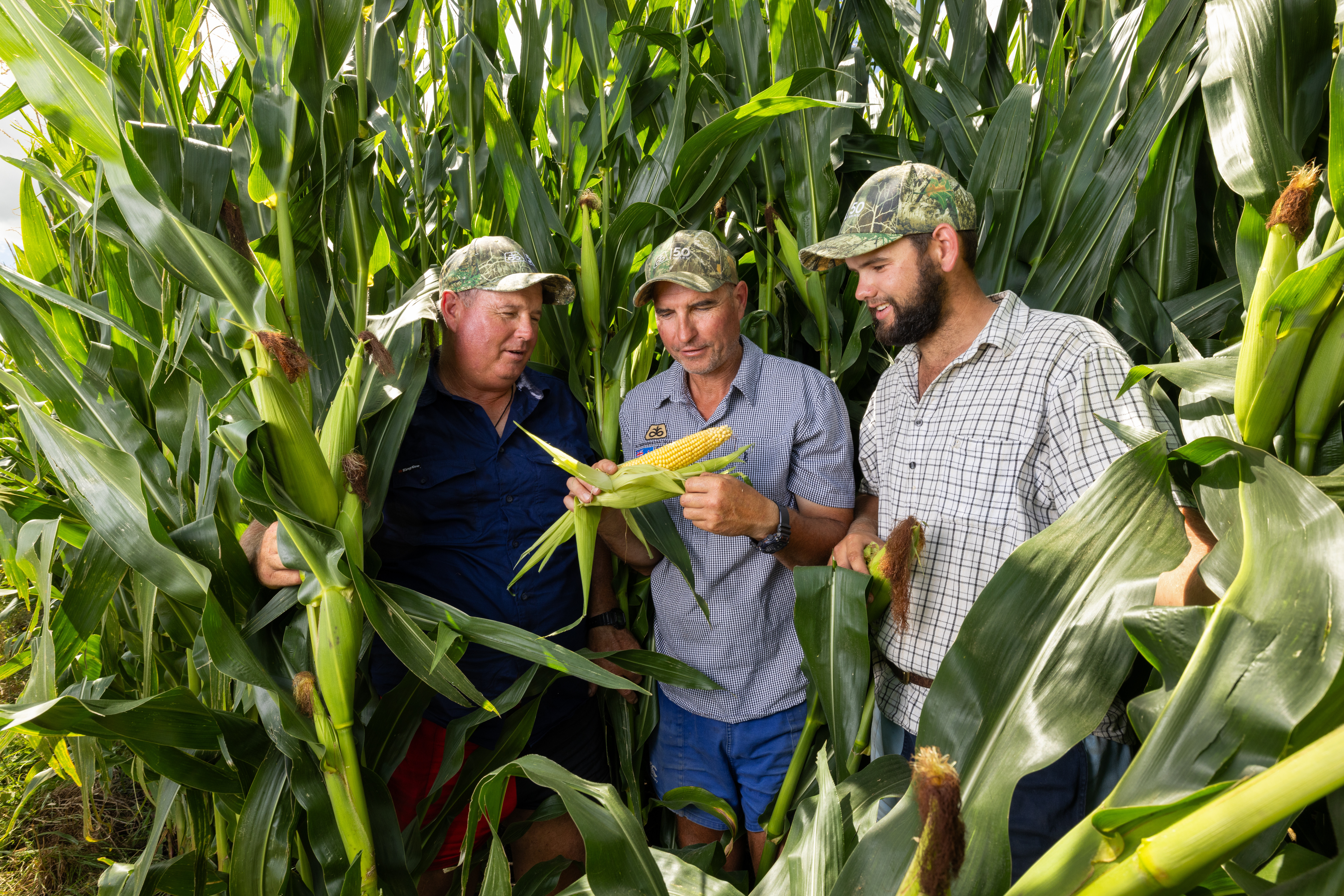
Pictured above: Craig, Donald, Michael
Maize grain plays multiple roles on the Stobie farm. It provides income diversification, spreads workload through the year and is a valuable development and regrassing tool. Growing a combination of grain and silage provides flexibility, as end use can vary depending on season conditions, market demand and price.
Donald believes that good seedbed preparation is a critical part of establishing high-yielding crops. Permanent or annual pasture is sprayed out and left to fallow for around two weeks to allow roots to break down. The first pass is normally with the chisel plough, and the paddocks are power-harrowed ahead of planting. The aim is a consistent seedbed that allows accurate depth control, uniform emergence and strong early vigour.
Planting generally takes place within an optimum window from mid- to late October, with timing dictated strictly by conditions rather than the calendar.
“Once we are in that window, we plant as soon as conditions allow it” says Donald.
Planting is carried out by a local contractor who pays careful attention to seed depth and spacing. Plant populations typically range between 85,000 and 105,000 seeds per hectare, adjusted according to paddock conditions and yield potential.
Hybrid selection is driven by resilience as much as yield. Seasonal risk is dominated by weather, events particularly summer storms.
“A cyclone in February is what an unfavourable season looks like” says Donald. “Wind damage, lodging or complete crop loss is largely out of our control, but choosing the right hybrid can help”.
“We’re looking for a strong, healthy plant with good disease resistance and the ability to yield when conditions allow but still perform in abnormal or unfavourable seasons”.
In the 2025-26 growing season, the family planted Pioneer® brand P0710, P0900 and P0937 for grain, and P1636 and P1185 for silage.
“We’ve had a long-term relationship with Pioneer” says Donald. “Pioneer seed quality is always very good, and their backup and support are second to none”.
The Stobies are constantly striving to maximise their maize crop yields. Their expectation was realised in the 2025 harvest when their commercial maize area yielded 18 t/ha and they also won the Paul Baker Cup for the highest maize grain yield in the Pioneer Maize Grain Yield Competition. Their winning entry of Pioneer® brand P1185 yielded 24.5 t/ha and broke the previous national record of 23.41 t/ha set by Gisborne grower Tom Newman in 2022.
Donald attributes their yield success to the combination of good maize genetics, timely management and a favourable growing season.
“It’s about planting at the right time, getting the crop nutrition and herbicide chemistry right, and eliminating as many obstacles as you can through the season”.
Nutrient management is based on regular measurement rather than fixed programmes. The farm is divided into 22 management blocks, with annual soil testing carried out each season, typically in late August. That timing allows results to be reviewed and decisions to be made well ahead of spring.
Base fertiliser applications are guided by an independent advisor who considers soil test results as well as crop yield potential. Nitrogen is split between starter fertiliser and side-dressed urea knifed in later to improve efficiency and reduce losses.
Weed control follows a proactive approach. A strong pre-emergence programme provides the foundation. Post emergence applications are assessed on a paddock-by-paddock basis, depending on seasonal conditions and weed pressure. Donald has trialled and used a range of options, including atrazine based programmes such as Atraflow®, as well as alternative chemistry including Arietta® or Dominator®. He notes that spring conditions play a significant role in determining the effectiveness of post emergence control with a key challenge being cooler, wetter seasons when weed growth can outpace the maize crop. Regardless of the mix used, the aim is to keep paddocks clean through to harvest to avoid yield loss later in the season.
“Once you’ve invested that much in a crop, it doesn’t make sense to let weeds take yield away” says Donald.
Average paddock size on the Stobie farm is small, at around 1.8 ha and this means a higher proportion of headlands and edge. Over time, paddock variability was identified as the main constraint to lifting average yield.
Over successive seasons, the family invested in drainage, contouring and targeted soil testing to identify nutrient constraints in lower-performing areas. Capital fertiliser applications were then used to lift those zones, rather than chasing marginal gains in already strong areas. Improving uniformity proved key to lifting whole-farm averages.
“What used to let us down was variability within paddocks, including wet patches where the water sat and places with lower fertility” says Donald. “We’ve addressed that and so now we are focusing on lifting the average paddock yield”.
Harvest timing reflects a balance between grain moisture, drying costs and the need to establish winter pasture. Grain is generally harvested from late April through to early May, with moisture targets set to allow efficient drying while still enabling prompt regrassing.
Each winter, the family buys in and finishes around 6,000 lambs on the maize ground, Lambs arrive on farm from May and are all gone by the end of September. They start by grazing the silage area (which is planted in grass in March) and the grass which was established after the grain crops comes available from July onwards. This approach allows the Stobies to generate winter income, protect soil structure with continuous cover, and keep paddocks in good condition ahead of the next maize crop.
With a strong foundation in place, the Stobies' focus remains on refining their system year by year, confident that maize will continue to play an important role in the business into the future.
“Maize is an enjoyable crop to grow, and we enjoy the challenge of trying to lift yields each year”.